
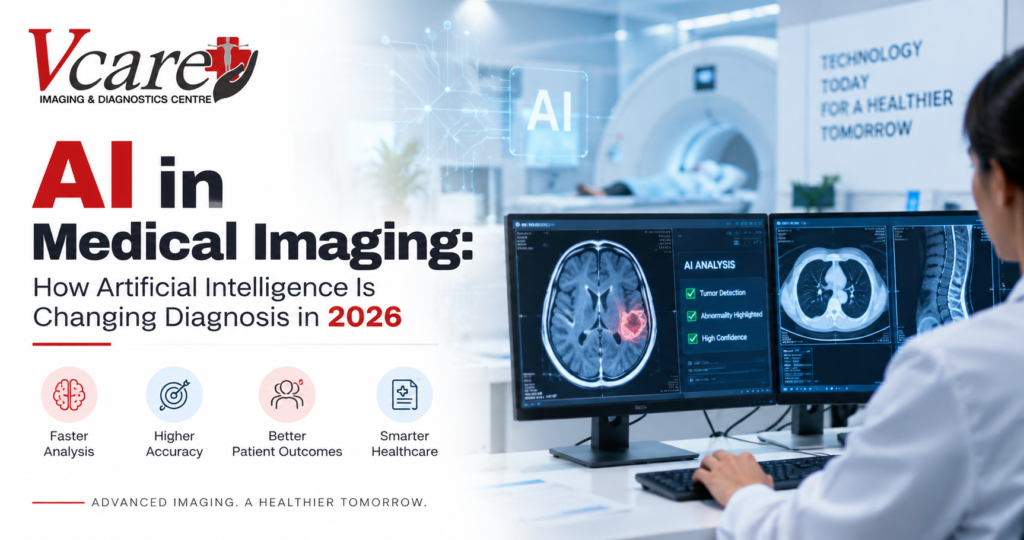
AI in Medical Imaging: How Artificial Intelligence Is Changing Diagnosis in 2026
Medical imaging has become an essential part of modern healthcare. MRI, CT scans, X-rays, ultrasound, mammography and other imaging technologies help doctors identify and monitor a wide range of medical conditions.
In 2026, AI in medical imaging is becoming an increasingly important part of this process. Artificial intelligence can help analyse medical images, identify patterns, highlight areas that may require attention and support healthcare professionals in making informed clinical decisions.
AI is not designed to replace radiologists or doctors. Instead, it is increasingly being developed as a supporting technology that can assist healthcare professionals with image analysis and workflow.
The U.S. Food and Drug Administration (FDA) maintains a growing list of authorised AI-enabled medical devices, including numerous technologies used in radiology and medical imaging.
What Is AI in Medical Imaging?
AI in medical imaging refers to the use of artificial intelligence and machine learning technologies to analyse, process and interpret medical images.
AI systems can be trained using large datasets of medical images. Depending on their intended use, these systems may assist with tasks such as:
- Detecting abnormalities in medical images
- Identifying suspicious areas for further review
- Segmenting organs, tissues or lesions
- Comparing imaging findings
- Supporting image reconstruction and processing
- Prioritising certain cases in clinical workflows
- Providing quantitative measurements
- Assisting radiologists with image interpretation
According to the FDA, applications of AI and machine learning in medical devices include image acquisition and processing, early disease detection, diagnosis, prognosis and risk assessment.
How Does AI Work in Medical Imaging?
AI-powered imaging systems generally rely on algorithms trained using large amounts of data.
A simplified process looks like this:
Medical Image → AI Analysis → Pattern Identification → Clinical Support → Doctor/Radiologist Review
For example, an AI system may analyse a CT scan and identify a region that appears unusual based on the patterns it has learned from its training data.
The system can then highlight the area for the radiologist to review.
The final clinical interpretation still depends on the healthcare professional, the patient’s medical history, symptoms and other relevant information.
This distinction is important because AI output should be considered as decision support, rather than an independent medical diagnosis.
How Is AI Changing Medical Imaging in 2026?
The role of AI in medical imaging is expanding across different parts of the diagnostic workflow.
1. Faster Image Analysis
Medical imaging can generate a large amount of visual information. Reviewing these images requires attention to detail and clinical expertise.
AI tools can assist by rapidly analysing images and identifying patterns that may need closer examination.
This can potentially help radiologists manage large imaging workloads more efficiently.
However, speed should not be confused with accuracy. AI systems still require appropriate validation and clinical oversight.
2. Supporting Early Detection
One of the major areas of interest in AI in medical imaging is the detection of subtle abnormalities.
AI algorithms can be trained to identify patterns associated with specific conditions.
For example, AI-based systems may assist in analysing:
- Lung imaging
- Mammograms
- Brain scans
- CT scans
- X-rays
- Cardiovascular imaging
- Musculoskeletal imaging
The goal is not simply to detect more abnormalities. AI tools need to be properly validated for their intended clinical application so that healthcare professionals can understand when and how their results should be used.
3. Improving Image Quality
AI can also be used in image acquisition and processing.
Some imaging technologies use AI-based techniques to help reconstruct or process images. This can be particularly relevant where imaging systems need to balance image quality, scanning time and other technical considerations.
The FDA specifically identifies image acquisition and processing as an area where AI/ML-based medical devices are being developed.
4. Helping Identify Areas of Concern
Another application of AI is highlighting potentially suspicious areas within an image.
Instead of requiring a radiologist to manually search every part of an image with equal priority, certain AI tools can draw attention to areas that may require additional review.
This can act as an additional layer of support within the diagnostic workflow.
5. Supporting Radiologists
AI in medical imaging is often discussed as though it is intended to replace radiologists. In clinical practice, the more relevant application is often human-AI collaboration.
Radiologists bring clinical knowledge, medical training and the ability to interpret imaging findings in the context of the individual patient.
AI can provide additional computational assistance.
Research published in Radiology has highlighted the growing number of AI-enabled radiology devices while also identifying challenges involving validation, interoperability, explainability, data availability and clinical implementation.
Which Medical Imaging Tests Can Use AI?
AI applications are being developed across several areas of medical imaging.
MRI
AI can assist with image reconstruction, segmentation and analysis of MRI scans.
Because MRI produces detailed images of soft tissues, AI-based image processing and analysis can be useful in specific clinical applications.
CT Scans
AI can assist with CT image processing and analysis.
Depending on the technology, AI may help identify particular findings, measure structures or support radiologists during image interpretation.
X-Rays
AI systems can analyse X-ray images for specific abnormalities and may assist healthcare professionals in identifying findings that require further review.
Mammography
AI is also being explored and deployed in breast imaging.
Certain AI-enabled systems can assist with mammography analysis, helping radiologists review breast images.
The FDA’s current AI-enabled device listings include multiple radiology applications involving mammography and other imaging technologies.
Ultrasound
AI can also support ultrasound workflows, including image acquisition, analysis and interpretation for specific applications.
The important point is that AI capabilities vary considerably between systems. An AI tool designed for one imaging application should not automatically be assumed to work for another.
Can AI Replace Radiologists?
No. AI should not be viewed as a replacement for radiologists.
Medical diagnosis involves much more than identifying a pattern in an image.
Doctors and radiologists consider:
- Patient symptoms
- Medical history
- Previous reports
- Laboratory results
- Imaging findings
- Physical examination
- Risk factors
- Other clinical information
AI can analyse images at scale, but clinical decision-making requires context.
The current direction of AI in medical imaging is therefore better described as AI-assisted diagnosis and workflow support.
The FDA’s ongoing regulatory work around AI-enabled medical devices reflects the need to evaluate their safety and effectiveness for their intended uses.
What Are the Benefits of AI in Medical Imaging?
When appropriately designed, validated and implemented, AI can provide several potential benefits.
Faster Workflows
AI can automate or assist with certain repetitive image-analysis tasks.
Consistent Quantitative Analysis
AI can help perform measurements and calculations consistently according to its programmed or learned parameters.
Support for Early Detection
Certain AI systems are designed to identify patterns associated with specific diseases or abnormalities.
Assistance With Large Imaging Volumes
AI may help radiology departments manage increasing volumes of medical images.
Better Workflow Prioritisation
Some systems can help identify cases that may require earlier attention based on their intended clinical function.
These benefits depend on the quality of the AI system, the data used to develop and validate it, the clinical environment and appropriate human oversight.
What Are the Limitations of AI in Medical Imaging?
Despite its potential, AI is not perfect.
There are several important challenges.
AI Can Make Errors
An AI system may produce incorrect results, including false positives or false negatives.
Therefore, AI output should not automatically be treated as a diagnosis.
Data Quality Matters
AI systems learn from data. If training or validation data are limited or do not adequately represent the intended patient population, performance may not generalise well to every setting.
Explainability Can Be Difficult
Some advanced AI systems can produce useful results without making it easy for users to understand exactly how the system reached a particular output.
This is an important consideration in healthcare.
Integration Can Be Complex
Introducing AI into a diagnostic workflow requires more than purchasing software.
Healthcare providers may need to consider:
- Existing imaging systems
- Data standards
- IT infrastructure
- Workflow integration
- Staff training
- Data security
- Regulatory requirements
- Ongoing performance monitoring
A 2025 review in Radiology noted that interoperability, explainability, standardisation, limited annotated data and clinical integration remain important challenges for AI in radiology.
Is AI in Medical Imaging Safe?
AI safety depends on how the technology is designed, validated, regulated and used.
Different AI systems have different intended purposes, and their performance needs to be evaluated for those specific applications.
The FDA states that AI-enabled medical devices included in its database have met applicable premarket requirements, including review of safety and effectiveness for their intended use.
Healthcare organisations also need appropriate safeguards for patient data, cybersecurity, clinical oversight and monitoring.
The World Health Organization has emphasised the importance of safety, ethics, transparency, accountability and human oversight in the use of AI in healthcare.
What Does the Future of AI in Medical Imaging Look Like?
The next stage of AI in medical imaging is likely to involve increasingly integrated systems rather than isolated AI tools.
Researchers are exploring technologies that can work with different types of information, including medical images and clinical data.
Multimodal AI is one area receiving significant attention.
The WHO’s 2025 guidance on large multimodal models notes that these systems can work with different types of data and may have applications across healthcare, while also highlighting the need for appropriate governance and safeguards.
Future imaging systems may increasingly combine:
Medical Images + Clinical Information + AI Analysis + Human Expertise
This could help create more connected diagnostic workflows.
However, technological progress alone is not enough. Clinical validation, responsible deployment, data protection and appropriate human oversight will remain important.
What Does AI Mean for Patients?
For patients, the most important point is that AI is becoming another tool within modern healthcare.
When used appropriately, AI may help healthcare professionals process medical images and support diagnostic workflows.
Patients should still focus on choosing a qualified diagnostic centre, appropriate imaging test and experienced healthcare professionals.
AI does not eliminate the importance of proper imaging protocols, skilled radiologists, accurate reporting and clinical correlation.
Frequently Asked Questions About AI in Medical Imaging
What is AI in medical imaging?
AI in medical imaging refers to the use of artificial intelligence and machine learning to process, analyse and interpret medical images. It can assist healthcare professionals with tasks such as detecting abnormalities, image processing and quantitative analysis.
Can AI diagnose diseases from scans?
Some AI systems are designed to detect or analyse specific findings associated with diseases. However, AI output should be interpreted within the clinical context and reviewed according to the intended use of the technology.
Does AI replace radiologists?
No. AI is primarily being developed as a tool to assist radiologists and other healthcare professionals. Medical diagnosis requires clinical context, professional judgement and consideration of information beyond an image.
Which scans can use AI?
AI applications are being developed for several imaging modalities, including CT, MRI, X-ray, mammography and ultrasound. The capabilities and intended uses differ between individual AI systems.
Is AI in medical imaging accurate?
Accuracy depends on the specific AI system, its intended use, training and validation data, and the clinical environment in which it is used. AI systems can make errors, which is why appropriate validation and human oversight are important.
Will AI become more important in radiology?
AI is already being incorporated into a growing number of radiology-related medical devices and workflows. The FDA’s AI-enabled device database continues to be updated as new technologies receive authorisation.
Conclusion
AI in medical imaging is changing how medical images are processed, analysed and incorporated into diagnostic workflows in 2026.
From CT and MRI to X-rays and mammography, artificial intelligence can support healthcare professionals by assisting with image analysis, identifying specific patterns, improving workflow efficiency and performing quantitative tasks.
At the same time, AI has limitations. It can make errors, depends on appropriate data and requires careful clinical validation.
The future of medical imaging is therefore unlikely to be about AI versus doctors. Instead, it is increasingly about combining advanced technology with medical expertise.
When AI, high-quality imaging technology and experienced healthcare professionals work together, the aim is to make diagnostic processes more efficient while maintaining patient safety and clinical oversight.
For patients, regular consultation with qualified healthcare professionals and appropriate diagnostic testing remain essential for accurate medical evaluation.
